Sunday, March 1, 2015

Welcome back

It has been a year since my last entry. A year full of events, disappointments, victories or just regular days. A year where I needed to find myself. A year where unknowns were keep coming up and stability has not arrived yet. But here I am and all this is called life; with its unforeseen events and its many questions: who am I, what should I do, what am I afraid of? These questions come around at night, when I lie in bed and listening to the silence from the other rooms. Yet, one day, all these questions will disappear. Even if I don’t know the answers, the questions vanish. To achieve that, I must take a decision. But what kind of decision? 

We all received a unique gift called life. And I must decide to live this life to the fullest. I can’t let that gift get away. 

So here I am, taking my kids and showing them the world. The world that is so huge but so small. China, Argentina, Germany, Hawaii, you name it and we will be there. The spirit of exploring new culture, new people, and a new language; adoption to the surrounding, embracing new ways of thinking and doing things have always been me. No one, who knows me, just a little, will be surprised to see me having a beer in Copenhagen, then the next day walking the street of Istanbul and having coffee, and a week later see me heading to Beijing with a detour to Maui. Yes, this might sound crazy but this is me. I live to travel, I live to explore and I live to learn. And when I get an opportunity to share those experiencing with people I love, and that makes me a complete person. This is a life experience that can’t be read in a book or taught in a classroom, this is an experience of letting it go, jumping into deep waters and swim. 

Welcome back. Let the journey of Math family continue and welcome to our world. 

Saturday, April 5, 2014

Success

We all want to experience the moment of success. 
Success is a steady realization of the goal set in front of us. One can have different goals, whether it is to become absolutely the best parent, or billionaire, or an astronaut. Movement towards the goal is already some sort of success as you are not standing still but constantly moving and that supposedly should give one some sort of satisfaction. 
While growing up I have learned that success is decisions, actions, the process, education and not bragging about it. 
We dream, and we go after our dreams. We fall, but we get up and continue. Everyday is full of small successes in our children or in ourselves, in our friends, work, but sometimes we do not notice these small successes. Either we are too arrogant, or too busy or too blind. 
As human beings it is hard to be happy for someone else's successes especially if it involves one way or the other yourself. There is so much jealousy and envy around and back stabbing is a common way of ensuring the prevention of these happy moments. Often I wonder why. Ofter I wonder what motivates people to be the way they are. 
My life has been far from a party. Loosing close members of the family, moving around, getting used to new surroundings, starting life all over again, but at the end of the day, my key to success is to look positive on life, use your noodle, be nice to the others, sincere and continue pursuing your goals. 
One thing for sure, my measurement of success still stands for the "old school" and somehow not with the young people born after 1990. 


PS: I learned the secret of the last unit of success if you're born prior to 1990: Post pictures with kids and/or kittens. And homemade muffins. Whatever you do, don't forget homemade muffins.

Friday, April 4, 2014

Way to survive in Denmark - 2 (or any workplace)

It is at the workplace where one gets to know how things work in the society.
In Denmark it is a workplace where you meet and get friends, it is a workplace where many relationships start and couples are formed. At most workplaces, there are often social events with your colleagues; they are optional but most of the people choose to be a part of those events one-way or the other. For example, something like celebrating a colleague birthday by organizing breakfast before the workday begins is something one would find everywhere. There are also common social and cultural activities outside the workplace and outside working hours. It is highly advised to participate in social life at work, for it is here that you get to know your colleagues and it is here where the ties are formed and new relationships develop.


You see - job satisfaction is not just about the academic satisfaction. In my understanding, there must be room for humor and socializing. The good atmosphere is essential. That is how we have to feel in order to do our job well. It is important that one pays attention to ones colleagues, not only as someone you work with but also as a whole individual with family, troubles and ups and downs.


When I ask “how are you doing?” I quite frankly expect an honest answer. In Denmark we talk about our lives, families, follow up with how we feel, how our children progress in activities and academics, our interests, even our sex life but for some curious reason, not our salary. Never our salary!


It is impossible to define Danish culture accurately, and that includes the culture at Danish workplace. However, there are certain common values ​​and cultural traits that most Danes take for granted, but when we move away, we miss that a lot. In order to describe this culture I picked up some examples of job advertisement from a Danish newspaper and translated them.


"We can offer you an exciting and dynamic organization with many challenges and great breadth of tasks where dialogue, development and influence is significant keywords - all seasoned with an informal atmosphere and good mood." (Vacancy for Municipality)


Most people put being equal, having a comfort, individuality and democracy in the centrum. The tone at the workplace is quite informal compared to many other countries. So, can you imagine to read like this announcement for a job in US or Canada?


"We seek a colleague who will help to create a good and eventful days with fun, humour and seriousness to our citizens." (Vacancy for Aarhus Municipality)


Comfort is an extremely important element in the "Danish culture". The Danes say "hygge" simply can’t be translated, but sooner or later one figures out that it is closely associated with having it nice and relaxed relationship weather it is with each other or with a glass of wine and a good book (or Dancing with the stars and a beer for a younger generations). Also a humorous tone is part of the Danish favourite social conventions -preferably with a considerable irony. Some would argue even that sarcasm is the code for the Danish mentality. And if you know me, I am a perfect example of that.


"There is an informal and flat structure that allows all to get involved in important decisions " (Glostrup Hospital)


The Danes are taught to talk, to discuss and share their opinions at home, at school and on the job. Actually it is already an important aspect of life in kindergarten. This means that they are used to and expect to be heard and to influence the decisions that are made. So things like I am the boss, I said so, you do it without questioning, goes so much against our nature and the way we function at work.


And going back to the friends, we distinguishes typically between friends and acquaintances - and friends will be visible only after prolonged acquaintance. However at the end of the day, both privately and professionally, we tend to build connections that are aimed to be long-term and trust-based that we will treasure for life.


Dedicated to Jens-Arne, Torben R, Henning, Peter, Torben J. and Søren, guys, who are still in my heart as the greatest bunch of colleagues back in Denmark, I have been surrounded with


Thursday, April 3, 2014

Consequences? Parenting basics (or so I thought).

I find it hard to understand the model of raising children in North America. I thought that there are prince and princesses in Scandinavia, but here, they are small monsters and manipulators as I can observe many children do not face any consequences for their behaviour. 
Ok, maybe I am too tough on my kids, but my circus will not be able to function if I will not have structure and help, my circus will not be able to travel and explore the world if I go alone with every caprice or hissy fit with my kids. But I do believe in fairness and creating human beings whom I will be proud of to ship into the open world. 

However, I find it so difficult to bring them up on this side of the ocean. Screaming, shouting, making hissy fits right in the middle of the shopping centre is absolutely a normal thing in any mall. And there are absolutely no consequences of bad behaviour, nasty speaking to the parents or being rude. I wonder how on earth do parents planning to see their kids being decent human beings and building the future. 
Recently I had an incident in the supermarket that not made me mad but also confirmed my observations. One of my kids, recently, has taken something out of the supermarket, without me paying for it. It was a small thing, a lipstick, costing maybe 50c or something like that. I could easily say, oh, get on with your life, but I chose not to do so. In fact, I drag the kid back to the supermarket, got to customer service and made the kid to explain how this little thing ended up in the pocket. The fact is I was hoping to teach someone a lesson and I was really hoping that a customer service worker will play along with me. But the fact is, the response I got shocked me. "So, you don't want this lipstick? You want to return it?" Ok, if it was an 18 years old one, that would be a criminal act, so for crying out loud, scare the kid so this will be remembered that for the rest of the life. But no, we get this smily young gentleman telling us,  that it is ok and thank you for returning the thing back to supermarket. People, is it me or is it wrong? I not only publicly humiliated my kid, made her publicly say that what she did was wrong but upon returning home, someone was not only grounded but had to perform extra home-duty to get her to understand the seriousness of her actions. 
Listen, I am not trying to raise my kids perfect. Oh no, we are far from perfect family in, I believe, almost all the aspects of life, but I am trying to raise responsible human beings who will understand the consequences of their actions and respect me and the society. 
So what I do? I let them fit into the society, by teaching them the basics: 

My answer: N-E-V-E-R

Wednesday, January 29, 2014

Way to survive in Quebec - 2

It is winter... It has been winter for a loooong time..... I remember my first year in Canada the winter lasted "only" 3 months. 3 months?!!! And they call it a short winter?!!! 
This year winter seems to be the worse of all. In Quebec they do get a week or two with constant -20 but that is usually close to the end of the winter, however this year it has been cold and cold for 2 months on the row. 
How how is winter in Quebec? The first answer that comes on the mind is... That the winter is REAL here. And it is CHANGEABLE, because one never know how it is going to be during the day, that it can change from bad to worse and to bad again. 
Generally I love winter. I love when it is -5 C, snowing a little... I love seeing my children having fun in the snow when weather permits. 

I remember back in my university years, I have travelled to the remote areas of Siberia and tried -40 occasionally, when it is almost impossible to go out. I even tried to freeze a tip of my nose which is since then a very sensitive to the cold weather. 
So how do they survive this hash climate:
1. Weather forecast. For many weather forecast is the first thing on the mind. And it is not that only the temperature but the windchill, which can create dangerously cold conditions. 
2. They dress warmly in layers with a wind and waterproof outer layer. 
3. Purchase the best warm boots and the best warm jacket on the market, even if will cost you a fortune. 
4. Attend winter festival. Dozens of cities throughout Canada hold festivals to celebrate the winter months.  
5. If you have the time and ability, try such activities as skating, sledging, cross country skiing or snowshoeing.
6. if you have a little more budget and close to the hill, do alp skiing. There are plenty of opportunities in here. 
Or.... 

Monday, January 13, 2014

Way to survive in Quebec - 1


There comes the time when one has lived long enough in the society to begin to detect interesting patterns of it.
For a long time, I was wondering why there is such a big difference between Francophone and Anglophone societies in Canada. One would think, you guys live in the same country, so there should be no difference between you. But no, this is absolutely not the case, no matter where one look.
I yet to fail to get a quebec francophone friend. Of all that time i have been living here, I have friends among French, Arab, Russian, Jewish, Canadiens but not Francophone Canadiens. And then you ask yourself a question, why is that? Am I different? I do not speak the language?
The answers can't be simple but let me try to answer those things for you.
The language? Well, one could think so, but then I think... Wait, I have French friends and we perfectly communicate with each other in Frenglish. Ahhh... then it is the continent... but wait, I have Anglophone Canadiens friends, absolutely awesome ones.... So what is it then?
As normal human beings we tend to find our own kind, no matter where we are and stick with them. Some nations are more open to others that other nations. The smaller nation is, the more trouble is has to imbrase the other nations. Why? Simple. We try to protect ourselves, our culture, our values from others. So, could it be mentality?
For a long time Francophone Canadiens were not allowed to get high posts, nor they were actually qualified for them. Many were farmers or sons of farmers and many posssed the lack of education and education.
The quite revolution of the 60s did change the whole province up side down. Quebec wanted separation, which resulted in many large international companies move their operations into Ontario but Francophone got their own "independence" perhaps not the way they intended but anyhow... Now they were encourage to go to universities, which many did and succeeded in that. So we think, great, fantastic, what is the problem. There is no problem, only that now, there is a pay back time, and the time, where people don't even realize what they do.
Many francophones did get an educations, but at the end of the day many are still "farmers in suits". Yes, they have an university degree but there is a major lack of that education which you receive at home in your surroundings. Many grew up on this "we are better now" and it is quite hard to deal with that in a proper way. In stead of getting better, many try to put others next to them down in order to look better themselves.
I wonder why? Why to do so? Is it because one has an inferiority complex? It is like you don't feel as good as the others so you try to deal with that by pushing the rest down. Is this a case of being oppressed for generations and now doing the same thing yourself? I am keeping wondering if English is a Language or a crime.
But I'll keep searching. And who know? I might be able to squeeze myself into the society and embrace and understand people that are forming it.


Friday, January 10, 2014

Way to survive in Denmark - 1

"Too big to fail".
"Too big to fail" is the expression that is connected to US financial crisis.

In 2010 Federal Reserve Chair Ben Bernanke introduced the term and defined is "A too-big-to-fail firm is one whose size, complexity, interconnectedness, and critical functions are such that, should the firm go unexpectedly into liquidation, the rest of the financial system and the economy would face severe adverse consequences
 
He continued that: "Governments provide support to too-big-to-fail firms in a crisis not out of favouritism or particular concern for the management, owners, or creditors of the firm, but because they recognize that the consequences for the broader economy of allowing a disorderly failure greatly outweigh the costs of avoiding the failure in some way. Common means of avoiding failure include facilitating a merger, providing credit, or injecting government capital, all of which protect at least some creditors who otherwise would have suffered losses...If the crisis has a single lesson, it is that the too-big-to-fail problem must be solved."


"Interest-only loan"

In 2003 a new form of loan was introduced in Denmark, an interest-only loan. And interest-only loan is a loan in which, for a set term, typically 10 years, the borrower pays only the interest on the principal balance, with the principal balance unchanged.

While buying a property in Denmark the common practice is to get a loan over 30 years. The loan is usually 80% of the total price of the property and it is expected to have 20% in cash. Many do not posses such an amount so there comes the bank loan on a much higher interest rate. While introducing an interest-only loan, the intentions were absolutely right. To allow, especially the new buyers to take the loan, save up the money from the principal balance and use them to repay the more expensive loan, such as bank loan and the, after the set term had ended, start paying a higher rate than normal because you now effectively have a 20 year regular mortgage.

But... what did really happen?

"Luxury trap"

The idea behind an interest-only loan is absolutely great and the intentions were right. But what did consumers really do with that money? Statistics has shown the consumption of flat-screen television, stereo, cars, vacations, steaks had increased dramatically. So why is that?

Back in Denmark, one of the shows that I absolutely loved watching was "Luxury trap". Not only because this show made me feel good (which I will not deny, it did) but also I tried to understand why and how people get into the bankruptcy situation and how to avoid the same fate.

But the major theme from one program to the other was the "misunderstanding" of the concept of the loans. Of course, if you get that kind of the advice

"Misunderstanding"?


"Misunderstanding"? The human nature is to consume and not safe. So what happens when people get more money between their hands? They start using them... I doubt that people were actually looking that far ahead and planning to pay all those borrowed money back.

And then I thought.... Wait a minute, what will happen if a critical mass of people in Denmark will get into the same situation of being on the edge of bankruptcy?
The social-democratic government will never allow the country to fail! In the beginning of the 21 century a major reforms on unemployment have been done and a stable economic development has been initiated.

So if a critical mass of people will get into trouble the government will kick in.

2014 will be an interesting year. This is the year were the first 10 year rate-only loans will end and I expect a massive change in a mortgage / bank systems. And I am sure social-democratic government will kick in one way or the other and save the day.

Unless... there is "Dancing with the stars" on the blue screens.
 

Sunday, November 10, 2013

Japan - Hakone

The next stop was Hakone. 
Day 1
Hakone welcomed us with even more rain - more then we expected. Right, and we had to take a public transportation into the heart of the district. So completely wet first we took the train, and then the bus, and then over the mountains into the valley. (Somehow google maps denied the existents of buses and suggested the more exotic route to the hotel, included 2 cable cards, 1 tram, 2 trans and about 30 min of walking) 
Completely tired (try to sit in a crowded bus with 3 kids and have all your luggage there at the same time), we have arrive at the hotel. 
So upon arrives, the girls hit the gym... NOOOO! The girls hit the hot springs. Oh, yes


So an onset is a term for hot springs. As being close to volcanically active place, we had the hot springs right in our hotel. There are both outdoors and indoors baths. They are a major attraction in Japan drawing thousands of people who want to get away form the hectic life and relax. In Japanese these baths more often called "naked communion" for breaking down barrios and getting to know people in the relaxes homey atmosphere. Traditionally, men and women bathed together at the onset but gender separation has been enforced since the opening of Japan to the West. And another interesting details about many onset bath is the people with tattoos, even when tattoos are small and "peaceful" are banned from using the baths. In Japan the tattoos are connected with a badge of criminality and despite of your reasons, the rules are the rules, strictly enforced against all.

So why the boys were doing... God knows what.... the girls hit the baths. Hot springs, sauna, lotions, cremes, and finally, we were ready for dinner.
While finding a suitable place just next to our hotel, we were ready for the next treat. 
We ended up to have a treat of waguy (literally "Japanese cow"). The meat from such waguy cattle is know for its quality, and demands a high price. Le me explain you something, because of Japan's isolated areas, different breeding and seeing techniques were used such as massaging (yes, you heard me right) and adding beer (yes, guys) or sake to their feeing regimen. This was done to aid in digestion and induce hunger during humid seasons, but it appears to have no effect on the meat's flavour. Massaging have been introduced to prevent muscles crampon on small farms in Japan where the animals did not have sufficient room to use their muscles. 
I must admit, the best meat I have tried. Could be my cattle was massaged more then usual, could be the effect of the spring baths but we all went to bed happier then ever. 

Day 2

Even more rain. Oh dear, right, we are from Denmark, we will not melt. So off we go, with 3 children again.                                             Luckily our hotel was pretty close to Lake Ashi, or Hakone Lake. It is a scrater lake that lies along the southwest wall of the caldera of Mt Hakone.  Several boats, designed to be sailing warships provide with a beautiful view of the surrounding. However, I believe marketing hasn't been the strongest in this part of the world. We all know that naming a boat "Titanic" probably the most wisest idea. So how about naming one of the ships "Vasa", you know after a Swedish warship build in 1626 and foundered and sank after sailing less than a nautical mile (1.5 km) into her maiden voyage on August 10th, 1628? 

Anyway at least during our sailing trip none bothered anyone with the safety instructions, so we could enjoy the scenery, a bit grey and foggy at times, but in the dry conditions. 


 Finishing with the ship we decided to try out the suggested route of Google maps and took a trip on the Hakone Ropeway to the Great boiling Valley, and then slowing going down with Hakone Tozan Cable Car funicular railway. I can only imagine us with 3 bags, a stroller and 3 kids on that route to the hotel... (I don't say it is not possible but I am grateful that Morten was able to find an alternative route) 

And then.... right in the mountains... the discovery of the trip...
HOT CAFFE LATTE AND FRENCH HOT-DOG! 
If you don't live in North America, you will not understand me. French hot-dog, that crunchy pork (yes, non-kosher) hot-dog. It just felt right, after the whole day when it was raining cats and dogs we got us a treat. 


Day 3

We woke up with the sunshine and right out of our window there is was...

Mt. Fuji - the highest mountain in Japan at 3,776.24 m (12,389 ft) and it is an active stratovolcano. It has exceptionally symmetrical cone. It is a well-known symbol of Japan and it is more a "sculptural" rather than a "natural" heritage site. And then you thing, wait a minute, where is the snow? Well... We asked ourselves the same question. The snow is there, but only several months a year, so the pictures we see on numerous postcards and calendars is there just not in October month. 


 The lake and the surrounding looked much more picturesque then the day before.

And now it was a time to visit the Great boiling Valley. Owakudani is a volcanic valley with active sulphur vents (smells like rotten eggs) and hot springs in Hakone. The smoke that you can see are not, as one our friends thought, clouds but volcanic activity. 

The boiled eggs turn black and smell slightly sulphuric but taste as a regular egg. Consuming the efts is said to increase longevity. Eating one, according to Japanese legend, is said to add seven (7!) years of your life (the children were informed about the circumstances of this meal). One may eat up to 2 and a half for up to 17 and a half years (YES!!!!) but earring a whole third is said to be highly unadvised.


So insuring that we will be around additional 17 and a half years, and at the same time deducting those years by breathing the "lovely" sulphur, which quickly deadens the sense of smell and with increasing quantities can quickly lead to death...
We enjoyed to the full the scenic views of the valley, lake and mount Fuji. 


Saturday, November 9, 2013

Japan - Tokyo

Something we thought of covering for a while but didn't have time so far.
Still suffering for a major jet-lag, I will try to use my time proper and divided between Visio diagrams and this blog.
Yes, we are back from Japan, a country where I spend my childhood and a so to say a "Disneyland" all over the place.
We spend about 2 weeks visiting friends (the whole purpose of the visit), travelling and trying to embrace and enrich ourselves with the culture.
Now from the beginning:
Japan met us 17 hours before we actually step on the soul of the islands, to be exact at JFK. Not only we got the treatment of a life time (Gold star alliance status of our children helps tremendously), but the fact of being a family with 3 children going to Japan for travelling (and not being stationed over there) is a rare thing for the staff. In my understanding flying with ANA airlines is quite uncommon as only 30% of the whole flight was booked. While throwing ourselves into Japanese dinner noodles we had a pleasant 14.5 hour non-stop flight to Tokyo.
Funny, I was not sure what expectations I had of Japan. When you are a kid, you see everything big, the weather is always sunny, the food is always horrible. Anyway, Tokyo saw quite chaotic the way I remember, big (I guess few more high-rises were build), colourful and rainy.
Day 1
Just getting over jet-lag and getting used to the surrounding. I decided to throw the guys into the deep and show them the kitchen of Japan.
  Somehow there is a myth that Japan is all about sushi. Japanese cuisine is not just the food, it is all about ingredients, process of preparation and way of eating it.
There are several rules regarding the food ethics, such as

  • It is customary to eat rice to the last grain. 
  • It is not customary to ask for a special requests at restaurants. 
  • Before eating you will be provided with either a hot or cold towel. This is for cleaning hands and hands only and before eating, not after. 
  • The proper usage of chopsticks is very important. Chopsticks are veneer left sticking vertically into rice, as this resembles some funeral rituals in Japan. 


It i the whole art of preparing the food. Observing the whole process, communication within the kitchen, which is actually right in front of you, is absolutely amazing. While some of the things look very wicked the taste is very good and fresh.
And of course it is absolutely necessary to have a great company at hand to join you for such a treat.
Day 2
 While coming to Japan to discover the cultural size of this amazing country, we walked into the temples, wondered on the street or just observed the people.
Ema (絵馬) are small wooden plaques where a worshipper can write his/her prayers or wishes. It is left handing up at the shrine, where the spirits receive them. Different shrines have different images that represent that particular place, and many include the word "wish" (願意). 

 As you know Japan is the Buddhist country. Buddhist temples exist side by side with Shinto shrines, and both share the features of Japanese architecture. Tori, the gates, that usually associated only with Shinto, can be found at both, but the entrance to a shrive can be marked by a gate which can dry often be found at temples as well.

It is amazingly peaceful sight right in the heart of Tokyo. One can see busies people coming in during their lucch breaks in their suits and ties, take off their shoes, say a prayer, ring the bell and go back to the chaos of Tokyo. While looking at the madness of the city itself I wonder how these two worlds can be side by side and play in harmony with each other.  

And of course the excuse of all trip was TUG 2013, where at the end of the day, we managed to see all our friends, get to know new people and just enjoy ourselves with a company of NERDS (sorry guys for the label (I am one of them)). 


 Day 3 
Transportation in Japan is a chapter of its own. Everything nice and clean, trains run on time and efficiently. The essential information is translated into English.  
 I absolute love observe people and metro is a good place to do so. I noticed quite a number of people, regarding the age group, play on Nintendo DS. I would probably correct myself, most grown-ups do so, while kids are actually reading books at the most. Tokyo suffers the same problem as New York or Toronto. It is very price to live in downtown, so people commute, sometimes up to 2 hours one way. So I guess this is the way of some kind of killing time for the regular person.
 Not only old temples and busy city life go side by side. The areas of Tokyo differ from each other. While being on one side of the main railway station the buildings are covered with commercials, people dry their laundry on the balconies (after using once a Japanese tumble dryer, I would do exactly the same), street food courts, and small shops.

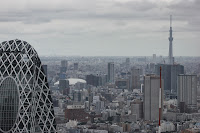
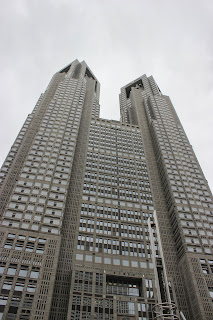
On the other side is the financial (as we will call it) district with massive high-rises, hotels, billion enterprises.   One thing that came on my mind was but what about the earthquakes that hit Japan now and then. Just during our visit there was a major earthquake about 300 km north, and in some area in Tokyo people could feel it. Why to build such a major construction, that potentially can be in the centre of the earthquake. But... remember we are in Japan. And of course Japanese architectures have thought about that as well. So what they did is that used the same technic as it is used in Japanese traditional pagodas. Despite being build without nails and metal parts, some multi-story pagodas have withstood destructive earthquakes and powerful typhoons.  Actually the sturdiness of these structures is due to their flexibility, achieved through their assembly method. During powerful winds or earthquakes, the tiers of the pagodas move independently as if performing an ancient snake dance. On in the case of an earthquake or typhoon, each of the pagoda's tiers vibrates and moves alternately in the opposite direction - so that when the first story of the pagoda sways to the left, the second floor swings to the right, etc. The snake-like movement re-established the balance of the structure in a natural way. The central column serves a a stopper for the base rafters battering against it whenever they are swaying too violently. This movement privets the pagoda or any other building from collapsing. 
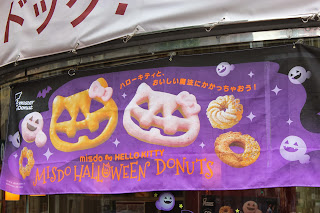
 And of course Japan would be Japan without Hello Kiddy, kimono and Japanese fashion that goes as far and having fashion shows for dogs.


Day 4
 
 Another important part of Japanese culture is a traditional tea ceremony. While the guys were hocked on coffee, the girls enjoyed their green tea. The manner in which it is performed, or the art of its performance, is called otemae and (お手前; お点前)  and Zen Buddhism was a primary influent in the development of the tea ceremony. However I will get back to that later.

While heading into the famous temple, we have stopped at the market just in front. I noticed some interesting masks that have been sold. The Hannya (般若) mask is a mark used originally in Noh theatre, represeting a jealous female or serpent (honestly, I do see some resemblance). It possess two sharp bull-like horns, metallic eyes, and a leering mouth split from ear to ear. The Hannya mask is said to be demonic and dangerous but also sorrowful and tormented, displaying the complexity of yuma emotions. When the actor looks straight ahead, the mask appears frightening and andry; whine tilted slightly down, the face of the demon appears to be sorrowful, as though crying. 


 And finally we made it to Senso-ji (金龍山浅草寺). It is an ancient Buddhist temple in Tokyo and one of its most significant.  The surrounding area has many traditional shops and eating places that feature traditional dishes (hand-made nodes, sushi, etc...). The street leading from the Thunder Gate to the temple itself, is lined with small shops selling souvenirs ranging from fans, Buddhist scrolls, from t-shirts to traditional kimono. These shops themselves are part of a living tradition of selling to pilgrims who walked to Senso-ji.

Whiin the temple itself, there are omikuji stalls. For a small donation, one amy consult the oracle and divine answers to their questions. One shake labelled sticks from enclosed metal containers and read the corresponding answers they retrieve fro one of 100 possible drawers.
And at the end a souvenir picture of local school girls and our Justin Bieber (spelled correctly this time). 
Day 5 (last day in Tokyo) 
One couldn't leave Tokyo without visiting Emperor palace. It is a main residence of the emperor of Japan. The total area including the gardens is 3.41 square kilometres. During the height of the 1980s Japanese property bubble, the palace grounds were valued by some as more the nthe value of all the real estate in the state of California, so how about that! If you want to live in style then that's the way to do it!
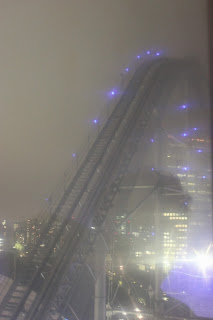


 And at last we made it that way that we will go to Tokyo Dome. Thunder Dolphin (サンダードルフィン) is something David will remember for a long time. It is a steel roller coaster which is 262 feet tall and the 6th tallest in the world. It is 1,100 m long course passes through both a hole in the LaQua building, and thought the Big-O, the world's fist centerless Ferris while. With the maximum speed of 130 km/h David hair was instantly dry and shaped accordantly where the wind was blowing.